
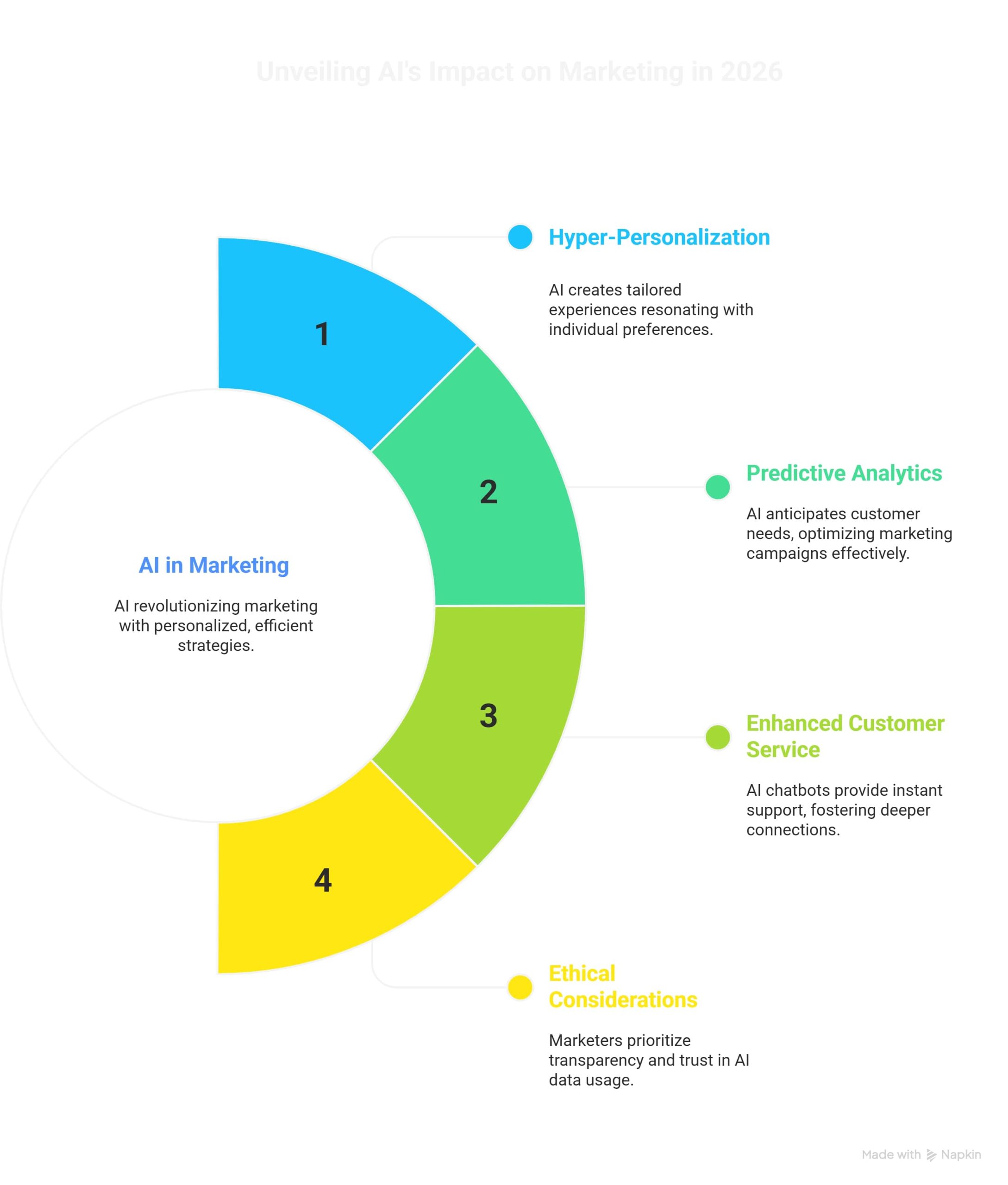
AI trends in marketing 2026 are set to redefine how businesses connect with customers, leveraging automation, personalization, and predictive analytics. The digital marketing landscape is shifting rapidly: by 2025, artificial intelligence moved from a shiny new toy to a fundamental component of the marketing stack. As we look toward 2026, the question isn’t whether you should use AI—it’s how you can thrive by embracing it fully. Among the most impactful AI trends in marketing 2026, hyper-personalization is taking center stage. Marketers who leverage AI trends in marketing 2026 can stay ahead of competitors.
We are moving past the experimental phase where businesses dabbled in generative AI for simple copy or images. The next wave is about integration, intelligence, and infrastructure. AI systems won’t just generate outputs—they’ll anticipate outcomes. For marketers, this means the difference between chasing trends and setting them.
This guide explores the pivotal AI trends in marketing 2026 that will define strategies, helping you build a competitive advantage in an increasingly automated world.
Trend 1: Hyper-Personalization at Scale: A Key AI Trend in Marketing 2026
If 2024 and 2025 were about segmentation, AI trends in marketing 2026 are about the individual. The era of “Dear [First Name]” is over. True hyper-personalization means delivering unique experiences to millions of customers simultaneously, driven by real-time data and AI-powered engines.
Moving Beyond Segmentation
Traditional marketing grouped people into buckets—millennials, tech enthusiasts, high-earners. AI tools now allow for “segments of one.” By analyzing vast datasets, AI can determine not just who a customer is, but what they need in a specific moment.
For example, platforms like Netguru highlight how AI transforms loyalty programs. Instead of generic point systems, predictive algorithms analyze individual purchase behaviours to offer rewards that actually matter to that specific user. This shift boosts engagement and lifetime value significantly.
Real-Time Adaptability
In 2026, your website won’t look the same to every visitor. AI will dynamically adjust content, images, and offers based on live user behaviour. If a visitor lingers on a specific product page, the homepage might instantly reconfigure to highlight related accessories or reviews. This level of fluidity turns static digital assets into living, breathing sales agents.
Trend 2: Predictive Analytics for Proactive Marketing: Driving Proactive Marketing AI Trends in 2026
Reactive marketing is expensive; proactive marketing is efficient. Predictive analytics is evolving from simple forecasting to complex scenario planning, allowing brands to solve problems before customers even realize they have them.
Anticipating Customer Needs
Imagine knowing a customer is likely to churn three weeks before they cancel their subscription. AI trends point toward systems that flag these risks and automatically deploy retention campaigns—customized discounts or check-in emails—without human intervention.
This proactive approach extends to inventory and trends as well. Brands using advanced analytics can predict viral trends on social media, adjusting their supply chains and ad spend accordingly.
Smarter Ad Spend
Wasted ad budget is a massive pain point for digital marketing. Predictive AI analyzes historical performance and market signals to allocate budget where it will have the highest impact. Tools like those analyzed by Anstrex help marketers understand competitive landscapes, ensuring that ad dollars are spent on winning strategies rather than guesswork.
Trend 3: AI-Driven Content Creation and Curation: Top AI Trends in Marketing 2026
Content is the fuel of the internet, but the engine has changed. Generative AI has democratized content production, but the challenge for 2026 is quality and coherence at scale.
Automating Strategy, Not Just Output
The next generation of AI tools won’t just write a blog post; they will manage the entire content lifecycle. Platforms like Beehiiv are leading this charge for newsletters. Their AI doesn’t just draft text; it translates, adjusts tone, generates images, and helps creators overcome writer’s block directly within the editor. This allows marketers to maintain a consistent publishing schedule without burning out.
The Rise of Intelligent Curation
With the volume of content exploding, curation becomes as valuable as creation. AI algorithms will help brands curate relevant industry news and insights for their audiences, positioning them as thought leaders. Agencies like Carney demonstrate the power of digital experiences that break through the noise, proving that even with AI, the human touch in strategy and design remains essential.
However, as AI-generated content floods the web, maintaining a distinct brand voice is critical. You cannot rely solely on raw AI output. It requires a “human-in-the-loop” approach to ensure the content resonates emotionally and aligns with your marketing strategy.
Trend 4: Ethical AI and Data Privacy: Important AI Trends in Marketing 2026
As AI capabilities grow, so do the responsibilities. By 2026, trust will be the most valuable currency. Consumers are becoming increasingly aware of how their data is used, and regulatory bodies are catching up.
Balancing Innovation with Responsibility
The “black box” era of AI is ending. Marketers must be transparent about when and how they use AI. If you are using a chatbot or an AI voice agent, disclose it. If you are using customer data to train predictive models, ensure you have explicit consent.
Resources like Sword and the Script frequently discuss the intersection of PR, marketing, and technology, highlighting that ethical missteps can cause irreversible brand damage. AI trends in marketing 2026
Privacy-First Marketing
With third-party cookies crumbling, first-party data is king. AI helps maximize the value of the data you own while respecting user privacy. It allows for “anonymized personalization”—delivering relevant experiences without needing to know a user’s entire life story. Brands that prioritize ethical data practices will win customer loyalty.
Staying Ahead with AI Trends in Marketing 2026
The future of marketing isn’t about robots replacing humans; it’s about humans leveraging machines to do what was previously impossible. The trends for 2026—hyper-personalization, predictive analytics, intelligent content creation, and ethical AI—are the pillars of a modern marketing strategy.
To stay ahead, audit your current stack. Are you using AI just to write emails, or are you using it to understand your customers? Explore strategic partners like Averi for AI consulting or Boss Creative for branding that connects on a human level despite the tech-heavy landscape.
The tools are here. The competitive advantage belongs to those brave enough to integrate them fully. To thrive, businesses must embrace the AI trends in marketing 2026 and integrate them into all strategies.
How will AI impact marketing jobs in 2026?
AI will shift marketing roles from execution-heavy to strategy-heavy. While AI handles data analysis, reporting, and initial content drafts, humans will focus on creative strategy, emotional connection, and ethical oversight.
Is generative AI safe for brand content?
Yes, but it requires oversight. Using tools to generate ideas and drafts is excellent, but human editors must review content to ensure accuracy and brand alignment. Reliable detection and strategy are key to maintaining trust.
What is the biggest risk of AI in marketing?
The biggest risk is the loss of trust through unethical data use or impersonal automation. Over-reliance on automation can make a brand feel robotic. Maintaining a “human-in-the-loop” approach is essential to mitigate this.
Where can I learn more about AI financial and business trends?
For a broader business context on AI investment and market movements, platforms like Yahoo Finance and AInvest provide up-to-date market data. For industry-specific insights, Fibre2Fashion covers AI in retail, while ALM Corp offers perspectives on legal and business implications.
Can small businesses afford enterprise AI tools?
Absolutely. The cost of AI tools is dropping. Many platforms now offer tiered pricing, making predictive analytics and advanced automation accessible to small businesses and startups, not just large enterprises.